Clean metal with a laser — rust, paint and oxide, without abrasive
The laser removes rust, paint and oxide from metal through a selective process, without abrasive and without stripping chemicals — with less residue to collect and reduced wear on the part. The effect depends on the material and parameters; test on a sample.
Sandblasting raises dust and consumes abrasive, while stripping chemicals are hazardous and leave residue to neutralise.
Rust, old paint and oxide on metal parts must be removed without destroying the metal underneath — and here every classic method has a cost. Sandblasting consumes abrasive, raises dust and can erode the part; chemical stripping brings hazardous substances and residue to neutralise; both require masking and cleanup afterwards.
Laser cleaning removes this trade-off. The beam vaporises exactly the unwanted layer through a selective process, without abrasive and without stripping chemicals, with reduced impact on the base metal. It uses no abrasive as a consumable and leaves little residue to collect — which is why it is used everywhere from metalworking shops to heritage restoration.
Below you will find the mechanism, the recommended equipment and what it means for costs and for the integrity of your parts.
Consequences
What classic methods cost you
- !Consumed abrasive and residue to collect after sandblasting
- !Hazardous chemicals and residue to neutralise
- !Wear on the part from aggressive sandblasting
- !Masking of zones that must not be touched
- !Dust and a work environment that is hard to control
The solution
How the laser cleans — through selective ablation
The laser beam vaporises exactly the unwanted layer (rust, paint, oxide) with low impact on the base metal. It uses no abrasive or stripping chemicals, leaves little residue to collect and can be finely tuned — including on areas where sandblasting would be too aggressive.
| Parameter | Value | Role |
|---|---|---|
| Mode of action | laser ablation | Vaporises the unwanted layer |
| Abrasive | zero | No abrasive; little residue to collect |
| Selectivity | high | No mechanical contact; the effect on the substrate is validated on a sample |
- The laser removes rust, paint and oxide through ablation, without abrasive and without stripping chemicals; the effect depends on material and parameters.
- A selective process — it acts only on the unwanted layer, with minimal impact on the base metal.
- No abrasive to buy (sand, shot, solvents) and no residue to neutralise; a little residue remains to collect.
- Adjustable for fine parts or delicate areas, where sandblasting would damage the surface.
See it for yourself
Rust, removed with laser — no sand, no abrasive
Eliminarea ruginii cu laser, fără tone de nisip – Tipora Rust Remover ProCommentary in Romanian.
Who it is for
The same problem, across several industries
Recommended equipment
Recommended equipment: TIPORA — laser cleaning
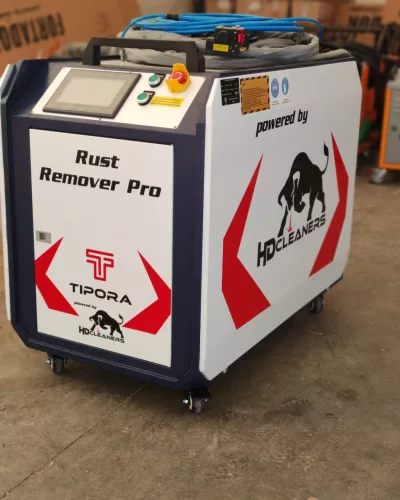
TIPORA Rust Remover Pro 3000W
A high-power laser for removing rust, paint and oxide from metal — no abrasive and no stripping chemicals, with tuning for every application (test on a sample).
Price excludes VAT and shipping costs
ROI and risk
No recurring abrasive, less time lost
- Eliminate the recurring cost of abrasive and solvents
- Less time spent on masking and collecting residue
- Less wear on parts than with sandblasting
- AUTONOM rental: monthly rental expenses may be tax-deductible, depending on your tax situation
Frequently asked questions
What we get asked most
Does the laser damage the metal under the rust or paint?+
What advantage does the laser have over sandblasting?+
Is there residue after laser cleaning?+
Show us what needs cleaning.
We'll help you decide what to test first.
Send us a few details, photos or a short video of the application. Within one working day, a technical sales consultant will review it and come back with the next best step — additional questions, a first recommendation or a proposed test.