Mould keeps coming back? Treat the surface — and find out why it returns
High-temperature dry steam can be an effective, low-water treatment for mould on compatible surfaces. But recurring mould is not just a cleaning problem: moisture, condensation, inaccessible joints, damaged materials or hygienic-design issues can matter just as much. We inspect the application first, test the surface, then recommend the process and the equipment.
If mould returns after cleaning, the cause may be residual or inaccessible contamination — but also condensation, persistent moisture, water ingress, damaged or porous material, process residues or a hygienic design problem. Cleaning treats the contamination; a recurrence calls for a separate diagnosis.
In food plants, mould is not a matter of appearance but of compliance. It appears in damp areas — cold rooms, washing zones, floor joints, ceilings in cooking areas — and it can return in the same places after cleaning.
If mould returns, the reason may be residual or inaccessible contamination — but also condensation, persistent moisture, water ingress, damaged or porous material, process residues or a hygienic design problem. Cleaning treats the contamination; a recurrence calls for a separate diagnosis.
Steam changes the logic: instead of adding a chemical, it adds heat to the treated surface, with very little water. But here is the limit we prefer to state openly: the treatment acts on the contamination on the surface, not on the condition that lets the mould come back.
Why it comes back — and what we are actually treating
When mould keeps appearing in the same area, the first question is not which substance or machine removes it fastest. It is what lets it return.
Recurrence can involve condensation, persistent moisture, leaks, inaccessible joints or seams, porous or damaged materials, process residues, access for cleaning, or hygienic-design issues. The cleaning method treats the contamination. The underlying condition has to be identified and, where relevant, corrected separately.
Clean the contamination. Diagnose the recurrence. Don’t confuse the two.
That is why we start with an inspection: which material is affected, where and how extensive the contamination is, where the moisture comes from, and what result needs to be verified at the end. Only then do we establish whether steam is the right method for that surface and which equipment makes sense.
Below you can see the mechanism, the parameters your hygiene officer can verify, the recommended equipment and what it means for costs and risk.
Consequences
What recurring mould can cost you
- !Repeated cleaning and labour
- !Extra downtime or a restricted area
- !Investigation or hold on a batch, depending on the incident
- !Escalation in food safety and at audit
- !Repeated spend on chemicals and consumables
- !Maintenance or remediation work on the building, if the moisture source remains
The solution
Treat the contaminated surface through a controlled process
Professional steam combines thermal energy, jet action and condensation at the target surface, together with the mechanical action of the chosen accessory where needed. For mould applications, the important question is not the nominal figure on the boiler, but whether the process reaches the required result on the actual contaminated surface, and what that material tolerates.
| Parameter | Value | Role |
|---|---|---|
| Pressure and flow | depends on the model | Determines how much energy reaches the surface and how fast you can work |
| Temperature at the treated surface | measured, not calculated | Together with contact time, this is the parameter that decides the result |
| Moisture source | identified at inspection | If left uncorrected, contamination can return regardless of the cleaning method |
| Low-water process | depends on the machine, accessory and surface | Steam condenses when it transfers heat to a cooler surface; the amount of condensate and the drying time depend on the machine, accessory, surface, contact time and application |
| Chemicals | zero in the steam step | Pure steam introduces no detergent or disinfectant residue in the steam step. Other chemicals may still be needed elsewhere in the facility's validated hygiene process |
- The result depends on the full application: the temperature actually reached at the surface, the contact time, flow and pressure, distance, movement, the accessory, the type of contamination and the material of the substrate.
- That is why we test the application before recommending the equipment.
- Steam is a low-water process, not a moisture-free one: it condenses when it reaches a cooler surface.
- Pure steam introduces no detergent or disinfectant residue during the steam step; other chemistry may still be required elsewhere in the validated hygiene process.
- Reaches joints, seams and hard-to-access corners where liquid cleaner or a cloth cannot.
- Steam treatment does not fix a leaking roof, does not stop condensation, and does not redesign an inaccessible joint. If the environment keeps favouring growth, the cause has to be corrected separately.
Laboratory evidence
What the laboratory report shows — and what it does not
For mould, the report contains one relevant organism: Aspergillus brasiliensis (ATCC 16404), tested under EN 13697 for fungicidal activity. That does not mean every mould or every deposit disappears; it means we have a laboratory result, with its conditions, that you can read and check. Below: what was tested and where the report stops.
In tests under EN 13697:2015+A1:2019, carried out in May 2024 by SANA srl (laboratory accredited by ACCREDIA no. 0747, ISO/IEC 17025), the General Vapeur platforms GV0218 / MK-2000 and GV0318 / MK-4000 achieved, with dry steam, a reduction of more than 4 log for bactericidal and more than 4 log for yeasticidal/fungicidal activity, under clean (0.3 % BSA) and dirty (3.0 % BSA + skimmed milk 1/20) conditions, at 20 °C, with contact times of 5 s and 20 s and the lance at 5–10 mm.
| Parameter | Value according to the report |
|---|---|
| Laboratory | SANA srl, Frosinone (Italy) — accredited by ACCREDIA no. 0747, ISO/IEC 17025 |
| Test dates | 17–22 May 2024 |
| Platform tested | General Vapeur GV0218 / MK-2000 and GV0318 / MK-4000, dry steam |
| Standard 1 | EN 13697:2015+A1:2019 (quantitative surface test, step 2) |
| Bactericidal result | reduction > 4 log |
| Yeasticidal / fungicidal result | reduction > 4 log |
| Conditions | clean (0.3 % bovine serum albumin, BSA) and dirty (3.0 % BSA + skimmed milk diluted 1/20) |
| Contact time | 5 s and 20 s |
| Test temperature | 20 °C ± 1 °C |
| Lance distance | 5–10 mm, continuous right-to-left movement |
| Standard 2 | AFNOR T72-110, Staphylococcus aureus, food applications |
| AFNOR result | reduction > 5 log (99.999 %), travel speed 10 cm/s |
| Organisms tested | Pseudomonas aeruginosa (ATCC 15442), Staphylococcus aureus (ATCC 6538), Escherichia coli (ATCC 10536), Candida albicans (ATCC 10231), Aspergillus brasiliensis (ATCC 16404) |
| Test configuration | dry steam 170–180 °C, a value declared for the test configuration |
Limits of this report
- The report supports no sporicidal claim: no spore-forming bacterium (for example Bacillus or Clostridium) was tested, and the EN 13697 conclusions mention only bactericidal and yeasticidal/fungicidal activity.
- A laboratory test under the standard does not replace validating the procedure in your own facility.
- 170–180 °C is the declared value of the test configuration, not a temperature measured on the surface.
- The fungicidal test uses a single mould (Aspergillus brasiliensis); it does not cover other species, mould embedded in the pores of a material, or the cause of the moisture.
- The report does not cover cracks, shaded areas or biofilm, only the conditions described in the standard.
- The report attests the platform tested under the conditions described; it is not a certificate of the product or the company and does not guarantee an audit result.
Questions about the report
Does the laboratory report replace validation of the procedure in my plant?+
Is dry steam sporicidal?+
Is there a “HACCP-certified” steam machine?+
Does it work on dirty surfaces as well?+
What about cracks, shaded areas or biofilm?+
Was the report issued for the Menikini MK2000?+
Does it completely replace chemical disinfection?+
With ATP measurement of organic residue, before and after, on your own surfaces.
See it for yourself
Mould on a conveyor belt — a real application demonstration. The footage shows a practical surface treatment; it does not by itself prove that the cause of recurrence was eliminated.
Mucegai pe bandă transportoare? Soluția profesionistă cu abur uscatCommentary in Romanian.
Who it is for
The same problem, across several industries
Recommended equipment
The equipment comes after the diagnosis
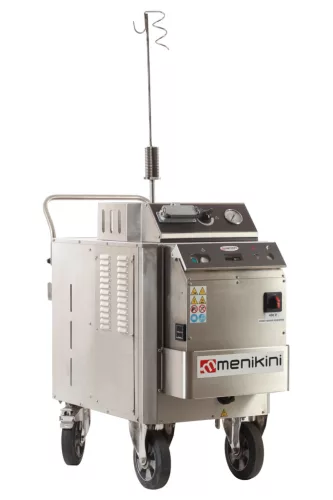
Menikini Steam Master Plus 19,5 SH
The type of surface, the contaminated area, access, cleaning frequency, the required steam flow, the number of operators and the verification goal all influence the choice of equipment. We first establish whether steam is suitable and what the process needs to achieve, then choose the machine and accessories.
Price excludes VAT and shipping costs
ROI and risk
Measure what a recurring mould problem costs
- Repeated cleaning: labour and frequency
- Stopping, isolating and restarting the area
- Current cost of chemicals and consumables
- Time needed to reach the contaminated areas
- How the result is verified
- Separate moisture, construction or hygienic-design work still needed
Frequently asked questions
What we get asked most
Does dry steam reduce mould contamination?+
Will steam stop mould from coming back for good?+
Why does mould return after cleaning?+
Can I use steam on food-contact surfaces?+
Is dry steam a moisture-free process?+
Can steam treat mould inside porous materials?+
How do we know the treatment worked?+
Show us what needs cleaning.
We'll help you decide what to test first.
Send us a few details, photos or a short video of the application. Within one working day, a technical sales consultant will review it and come back with the next best step — additional questions, a first recommendation or a proposed test.