Reduce chemical use in food-production hygiene — and validate the result.
The goal is not to swap one product for another, but to keep a cleaning process that is controlled, repeatable and verifiable. We start from the real surface, the soiling and the hygiene target, then we test whether steam can reach the result your process requires.
Chemical cleaning and disinfection can be appropriate and validated. In the right applications, dry steam can reduce or eliminate some process steps: chemicals, rinsing or drying. The site's validated hygiene plan sets where detergent or disinfectant remain necessary.
For a food-production manager or a restaurant owner, the real question is not which machine to buy, but how to pass the next audit without trouble. And the current method — chemical detergents and disinfectants — can be appropriate and validated: it passed the audit last year too.
Chemical cleaning and disinfection are not the problem in themselves. In the right applications, dry steam can reduce or eliminate some process steps: chemicals, rinsing or drying. The site’s validated hygiene plan sets where detergent or disinfectant remain necessary. The useful question is what can be measured differently in your process.
What HACCP actually requires at the disinfection step
HACCP does not mandate a specific chemical. It requires that the sanitising of food-contact surfaces be effective, verifiable and documented. The sanitising step almost always has two components: first cleaning (removing dirt and grease), then disinfection (reducing the microbial load below a safe threshold). Which method you use for disinfection is up to you, as long as the result is demonstrable.
This is where the common misunderstanding arises: reducing chemicals does not mean you give up on HACCP or documentation. In the right applications, thermal disinfection can supplement or replace a chemical step — the rest of the plan (frequencies, responsibilities, records, checks) stays in the site’s validated procedure.
Where steam can help in the process
In HACCP logic, cleaning and disinfection chemicals are managed as a potential chemical hazard, and the site’s procedure sets the rinsing, concentrations and contact times. Each chemical step brings labour, consumables and a rinsing step to control.
Pure steam, made from water, does not introduce detergent or disinfectant residue in the steam step. In the right applications, this can shorten or remove some rinsing or drying steps. How much is actually gained — in cleaning time, chemicals or downtime window — we do not publish as a general promise: we measure the real effect in your process, at the demonstration.
What actually decides the result
This is the point where many datasheets mislead: the suggestion that a single number — boiler pressure or the machine’s maximum temperature — proves the hygiene result on its own. It does not.
Pressure and flow show how much the machine can deliver: how much energy reaches the nozzle and how many operators can work at once. Those are real criteria when choosing a machine. But the result on your surface depends on the full application: the temperature actually reached at the treated target, exposure time, working distance, travel speed, the geometry of the accessory, the type and amount of soiling, and the material of the surface.
The practical consequence is simple: a figure quoted without its measurement conditions tells you nothing about your process. That is why we do not rank steam machines for hygiene applications by pressure alone, and why, when hygiene performance matters, we validate the process against the required result — on the real surface, under your working conditions.
Steam is a low-moisture process, not a moisture-free one: it condenses when it reaches a cooler surface, and the loosened soiling still has to be managed. The real advantage stays that pure steam, made from water, does not introduce detergent or disinfectant residue onto food-contact surfaces.
Where the problem appears — zones and industries
The same pain recurs across different industries: a bakery with recurring mould in damp areas, a slaughterhouse where grease and biofilm build up on belts and machines, a bottling line with hard-to-reach spaces, a HoReCa kitchen where the sanitising window between shifts is just a few dozen minutes. In all of them, the critical surfaces are the same: stainless steel, countertops, hoods and ventilation, cold rooms, joints and seams, packaging equipment.
For each of these zones, the steam parameters (pressure, flow, nozzle type) are adjusted to the material, and sensitive surfaces are tested first.
How to validate and document the result
Validation uses the methods the site’s hygiene plan defines: ATP/bioluminescence tests, surface (swab) samples or laboratory analysis, before and after sanitising, compared against the internal threshold. The results are recorded in the same monitoring records as before.
One point here is worth pressing, because most suppliers walk around it. Normally, “clean” is a judgement call: the surface looks clean, so you move on. An ATP tester takes the judgement out of it for organic residue: it detects adenosine triphosphate — the molecule present in every living cell and in any organic residue — and turns the result into a number, expressed in RLU. It is useful for before/after comparison and routine monitoring. It is not a microbiological test, though: the right threshold depends on the device, the surface and the site’s hygiene programme, and where evidence for a specific microorganism is required, the matching lab method is used.
The practical consequence is simple: measure the same surface before and after sanitising and you have two numbers. Not an impression, not a supplier’s promise — two values you can enter in your HACCP records and show to an auditor. At the demonstration on your premises we bring the Lumitester and measure together, before and after cleaning, on your surfaces and with your real soiling — you are left with two measured values, not a promise.
Below you can see the mechanism with the exact parameters a HACCP officer can verify, the recommended equipment and what this change means for costs and risk.
Consequences
What an unvalidated hygiene process can cost you
- !Repeat cleaning and retesting
- !Production delays while the problem is corrected
- !Product hold or investigation, depending on the incident
- !Additional corrective-action work
- !Extra labour, water and chemical-handling steps
- !Customer or auditor escalation
The solution
Dry steam works through a process — not through one temperature number
Professional steam cleaning combines thermal energy, jet momentum, condensation at the target surface and, where needed, the mechanical action of the chosen accessory. HACCP is a process-control system, not a certificate attached to a machine: a steam process can be built into the cleaning and sanitising programme once the site validates that it reaches the required hygiene result.
| Parameter | Value | Role |
|---|---|---|
| Pressure and flow | model-dependent | Determines how much energy reaches the surface and how many operators can work at once |
| Temperature at the target surface | measured, not calculated | Together with exposure time, this is the parameter that decides the result |
| Distance and travel speed | set during the application test | Directly changes the real exposure of the surface |
| Water and condensate | depends on the machine, accessory and surface | Steam condenses on cooler surfaces; the amount of condensate and the drying time are measured in the application test |
| Residues | no detergent or disinfectant residue in the steam step | Other chemicals may remain necessary elsewhere in the site's validated hygiene process |
| Verification | set in the hygiene plan | The right threshold depends on the device, the surface and the site's programme; where microbiological evidence is required, the matching lab method is used |
- The result depends on the full application: the temperature actually reached at the target surface, the exposure time, pressure and flow, distance, travel speed, the accessory, the type and amount of soiling, and the material of the surface.
- That is why we validate the application on the real surface, instead of recommending a machine off a catalogue figure.
- Pure steam, made from water, does not introduce detergent or disinfectant residue. Steam does condense on cooler surfaces, though, and the loosened soiling still has to be managed.
- Dry steam can reduce or eliminate process chemicals in the right applications; the hygiene procedure is still what defines the parameters, verification, frequency and corrective actions.
- Your HACCP plan stays complete: cleaning and monitoring are documented exactly as before.
- Low-water process: steam condenses when it transfers heat to a cooler surface. The amount of condensate and the drying time depend on the machine, accessory, surface, contact time and application.
- ATP testing gives a fast, on-the-spot reading of the biological and organic residue left after cleaning, useful for before/after comparison and routine monitoring.
- For organic residue, cleanliness stops being only a subjective judgement: an ATP test gives a number, measured before and after, that can go into your HACCP records.
Laboratory evidence
What the laboratory report shows — and what it does not
For dry steam, the only proof we can show is an accredited laboratory report, with its conditions. Below: what was tested, what result was obtained, and where the report's claims stop.
In tests under EN 13697:2015+A1:2019, carried out in May 2024 by SANA srl (laboratory accredited by ACCREDIA no. 0747, ISO/IEC 17025), the General Vapeur platforms GV0218 / MK-2000 and GV0318 / MK-4000 achieved, with dry steam, a reduction of more than 4 log for bactericidal and more than 4 log for yeasticidal/fungicidal activity, under clean (0.3 % BSA) and dirty (3.0 % BSA + skimmed milk 1/20) conditions, at 20 °C, with contact times of 5 s and 20 s and the lance at 5–10 mm.
| Parameter | Value according to the report |
|---|---|
| Laboratory | SANA srl, Frosinone (Italy) — accredited by ACCREDIA no. 0747, ISO/IEC 17025 |
| Test dates | 17–22 May 2024 |
| Platform tested | General Vapeur GV0218 / MK-2000 and GV0318 / MK-4000, dry steam |
| Standard 1 | EN 13697:2015+A1:2019 (quantitative surface test, step 2) |
| Bactericidal result | reduction > 4 log |
| Yeasticidal / fungicidal result | reduction > 4 log |
| Conditions | clean (0.3 % bovine serum albumin, BSA) and dirty (3.0 % BSA + skimmed milk diluted 1/20) |
| Contact time | 5 s and 20 s |
| Test temperature | 20 °C ± 1 °C |
| Lance distance | 5–10 mm, continuous right-to-left movement |
| Standard 2 | AFNOR T72-110, Staphylococcus aureus, food applications |
| AFNOR result | reduction > 5 log (99.999 %), travel speed 10 cm/s |
| Organisms tested | Pseudomonas aeruginosa (ATCC 15442), Staphylococcus aureus (ATCC 6538), Escherichia coli (ATCC 10536), Candida albicans (ATCC 10231), Aspergillus brasiliensis (ATCC 16404) |
| Test configuration | dry steam 170–180 °C, a value declared for the test configuration |
Limits of this report
- The report supports no sporicidal claim: no spore-forming bacterium (for example Bacillus or Clostridium) was tested, and the EN 13697 conclusions mention only bactericidal and yeasticidal/fungicidal activity.
- A laboratory test under the standard does not replace validating the procedure in your own facility.
- 170–180 °C is the declared value of the test configuration, not a temperature measured on the surface.
- The report does not cover cracks, shaded areas or biofilm, only the conditions described in the standard.
- The report attests the platform tested under the conditions described; it is not a certificate of the product or the company and does not guarantee an audit result.
Questions about the report
Does the laboratory report replace validation of the procedure in my plant?+
Is dry steam sporicidal?+
Is there a “HACCP-certified” steam machine?+
Does it work on dirty surfaces as well?+
What about cracks, shaded areas or biofilm?+
Was the report issued for the Menikini MK2000?+
Does it completely replace chemical disinfection?+
With ATP measurement of organic residue, before and after, on your own surfaces.
See it for yourself
Dry steam vs alcohol disinfectant — an application demonstration. The footage shows the practical cleaning and verification workflow; it does not replace a lab validation.
Igienizare în industria alimentară: abur uscat vs dezinfectanți alcoolici | HACCP și IFSCommentary in Romanian.
Who it is for
The same problem, across several industries
Recommended equipment
The machine comes after the application
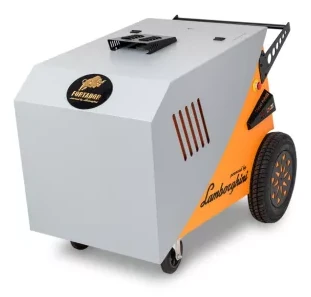
Fortador Pro Max 16 Bar
Required steam output, mobility, operator count, accessories, cleaning frequency and the hygiene target all influence equipment selection. HD Cleaners works with several professional steam configurations, and we recommend the machine only after we understand what has to be cleaned and how the result will be verified.
Price excludes VAT and shipping costs
ROI and risk
Measure what changes in your cleaning process
- Possible reduction in the recurring use of detergents and disinfectants, in the suitable process steps
- Possible reduction in rinsing or drying steps, where the validated procedure allows it
- Measure before and after the test: cleaning time, labour, chemicals, water and downtime
- ATP can support rapid monitoring of organic residue; it does not prove microbial reduction and does not replace microbiological validation
- AUTONOM rental: monthly rental expenses may be tax-deductible, depending on your tax situation
Frequently asked questions
What we get asked most
Can I integrate dry steam into my HACCP plan?+
What decides whether steam sanitising is effective?+
Does steam leave residue on food surfaces?+
Does higher pressure automatically mean better sanitising?+
How much does a dry-steam machine cost?+
On which surfaces and zones can dry steam be used?+
How do I validate that the thermal disinfection worked?+
What is an ATP test and why does it matter at an audit?+
Does dry steam also replace the cleaning step, or only disinfection?+
In which industries does this method apply?+
Show us what needs cleaning.
We'll help you decide what to test first.
Send us a few details, photos or a short video of the application. Within one working day, a technical sales consultant will review it and come back with the next best step — additional questions, a first recommendation or a proposed test.