Dry-Ice Blasting: What It Removes, What It Does Not, and What It Needs
A production line stops because residue has built up on moulds, conveyor parts, drive housings or electrical cabinets.
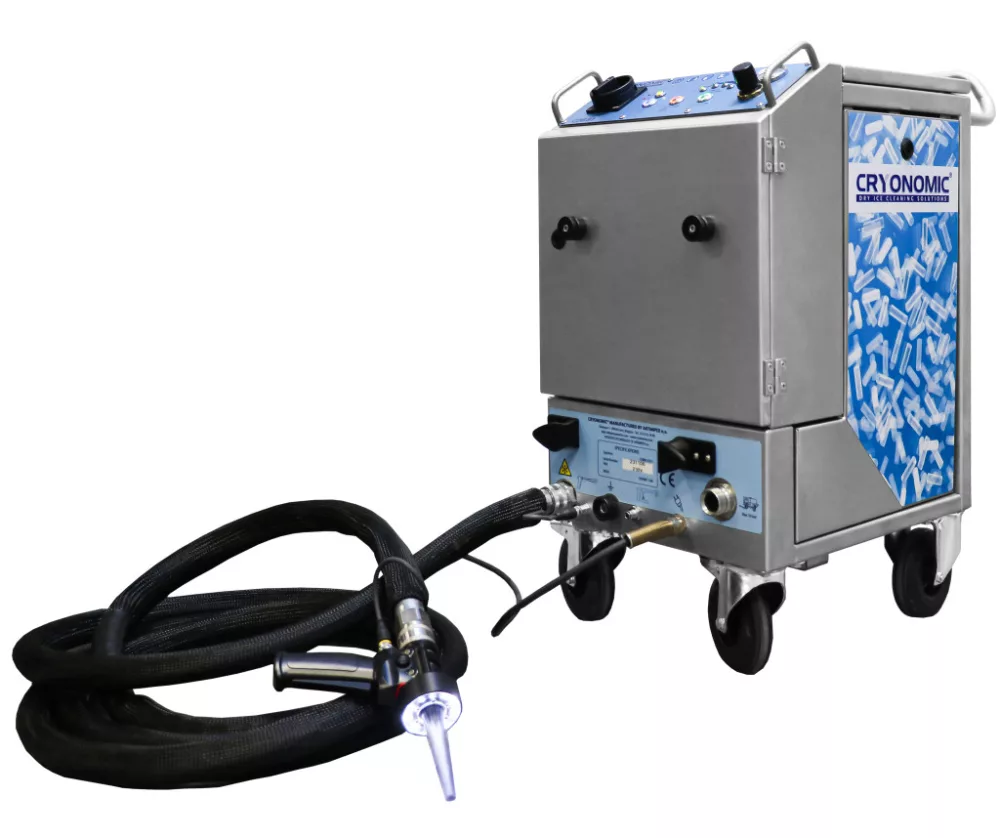
A production line stops because residue has built up on moulds, conveyor parts, drive housings or electrical cabinets. Wiping takes time and does not reach into profiles. Water creates drying time and corrosion risk. Solvents bring extraction and storage obligations. Dry-ice blasting is one answer to that situation, and it is the wrong answer to several others. This page explains both sides.
How the process works
The machine feeds solid CO2 pellets into a compressed-air stream and accelerates them through a nozzle onto the surface. Three effects act together: mechanical impact, thermal shock at the boundary between contamination and substrate, and the rapid expansion of the pellet into gas, which lifts the loosened layer. The pellet changes from solid to gas on impact. What remains on the floor is the removed contamination only — the blasting medium itself does not stay behind as a residue to be collected.
| Parameter | Value and condition |
|---|---|
| Blasting medium | Solid CO2 pellets, typically 3 mm diameter, food-grade CO2 |
| Pellet temperature | Approximately −78.5 °C at atmospheric pressure |
| Compressed air | Dry, oil-free; working pressure and air flow depend on the machine and nozzle — see the datasheet of the specific model |
| Effect on substrate | Non-abrasive on hard metal surfaces; abrasiveness comes from the contamination layer, not from the pellet |
| Secondary material | Only the detached contamination; the CO2 passes into the air as gas |
| Mandatory condition | Ventilation or CO2 monitoring in enclosed or low-lying areas; hearing and hand protection for the operator |
Where it fits
Dry-ice blasting works well on release-agent and polymer build-up in injection and blow moulds, on baked-on grease and product residue in food and beverage production, on conveyor structures and dryer housings, on electric motors and control cabinets where water is unwanted, and on soot or oil films in maintenance work. Whether a specific layer comes off, and how fast, depends on the surface and the contamination. In many cases parts can be treated in place; whether that is possible depends on access, on the surrounding equipment and on your own safety rules.
In food production the process supports a hygiene plan by removing visible soiling and build-up from equipment surfaces. It does not replace the chemical and microbiological steps defined in that plan, and no cleaning process certifies hygiene status.
Where it does not fit
Firmly bonded rust and mill scale on steel before painting: dry ice removes loose material but not an oxide layer that is chemically bound to the metal. Sandblasting or laser cleaning is the correct route there. Mineral scale and limescale: use high-pressure cleaning or an appropriate chemical method. Thick, soft, liquid grease: dry steam or high-pressure cleaning is usually faster and cheaper per square metre. Soft plastics and elastomers: cold makes some polymers brittle, so a test on a representative sample is required before any production use. Very small, fully enclosed cavities: the gas needs a way out, otherwise the layer is not lifted.
Cost, operation and limits
The running cost consists of dry ice consumption, compressed air and operator time. Pellets sublimate continuously in storage, so the quantity ordered should match the planned work, not the calendar. The compressor is often the deciding factor: an undersized air supply reduces cleaning speed more than any setting on the machine. Noise during blasting requires hearing protection, and the nozzle must never be directed at people.
HD Cleaners supplies dry-ice blasting equipment including CRYONOMIC, and services it from Miercurea Ciuc. Purchase, GRENKE leasing or AUTONOM long-term rental are available; monthly rental costs may be tax-deductible, depending on the client’s accounting and tax situation.
FAQ
Will it damage my mould surface? On hard tool steel the pellet is non-abrasive. On coated, polished or soft surfaces, test first on a representative part.
I am far from Miercurea Ciuc. Can I still see it work? Yes. Visit the showroom, send or bring a representative part for a test, request a test on your application, or an on-site demonstration where it makes sense. You receive the full technical datasheet before any purchase.
Do I need a special compressor? You need dry, oil-free air at the pressure and flow stated in the datasheet of the model you choose.
Describe your problem — the part, the layer, the surface — and the team in Miercurea Ciuc will tell you whether dry ice is the right method or another one is.