Removing paint without abrasive: what laser cleaning does, and where it does not fit
HD Cleaners supplies non-abrasive paint removal equipment and services it from Miercurea Ciuc, Romania.
The problem with abrasive stripping
Sand or grit removes paint by cutting into the surface. The coating goes, but so does part of the substrate. On thin sheet metal you get deformation. On precision surfaces, sealing faces and moulds, you lose geometry. Afterwards you have spent abrasive mixed with paint to collect and dispose of, and dust in places where dust causes a second problem.
If the part has to keep its dimensions, abrasive is the wrong starting point.
The mechanism: energy instead of impact
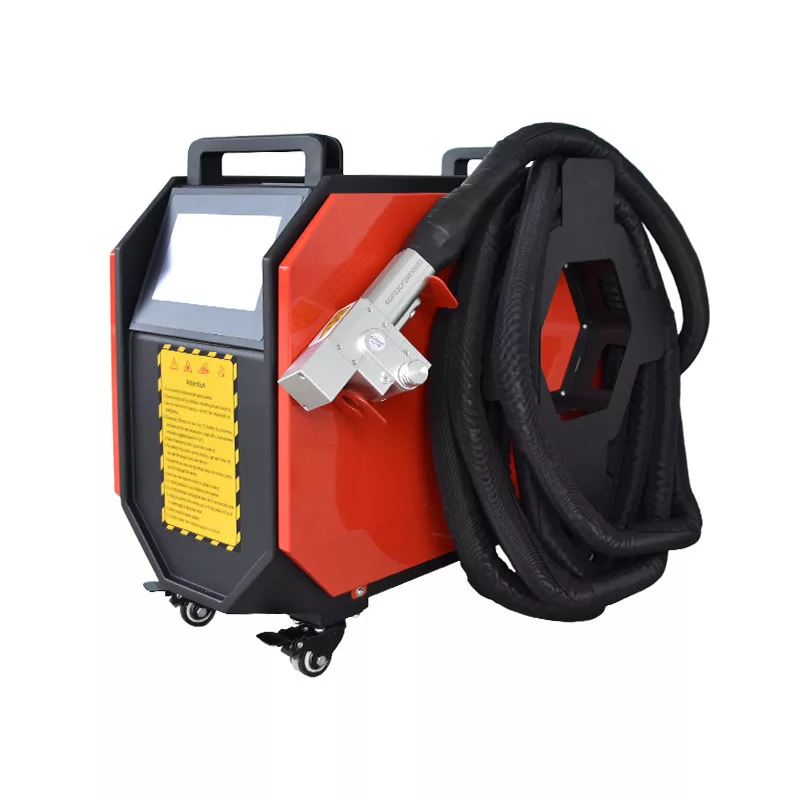
Laser cleaning removes a coating by absorbing pulsed light in the layer itself. The layer heats, breaks down and is carried away by the extraction unit. The metal underneath reflects more and absorbs less, so the process tends to stop at the substrate. There is no blasting medium, so there is no spent abrasive to collect. Removal depends on the substrate, the coating type and the layer thickness.
Ultrasonic cleaning is the other non-abrasive route, for small parts that fit into a tank and for coatings that respond to a cleaning agent.
| Technology | Typical use in paint removal | Where it does not fit |
|---|---|---|
| Laser cleaning (TIPORA, among others) | Paint, primer and coating layers on metal; selective removal on defined areas | Large areas of thick multi-layer coating, where blasting is faster |
| Ultrasonic cleaning | Small parts, racks, fixtures, hooks in a tank | Parts too large for the tank; coatings the agent does not attack |
| Dry-ice blasting (CRYONOMIC, among others) | Release agents, grease, soot, production residue | Well-bonded paint; it is generally not a paint stripper |
| Sandblasting | Thick coatings and rust on robust steel structures | Precision surfaces and thin sheet where substrate loss matters |
What you should expect to clarify first
Substrate material, coating type, layer thickness, surface area and the condition required afterwards. These decide whether laser is the right method or whether blasting remains the honest answer for your part.
“Miercurea Ciuc is far from us”
That is a fair objection. You do not have to travel to find out whether the method works. Send or bring a representative part for a test, book a visit to the showroom, ask for a test on your own application, or request an on-site demonstration where it makes sense. You receive the full technical datasheet before any purchase decision.
Equipment can be purchased, financed through GRENKE leasing, or taken as long-term rental through AUTONOM. Monthly rental costs may be tax-deductible, depending on the client’s accounting and tax situation.
Show us what needs cleaning.
We'll help you decide what to test first.
Send us a few details, photos or a short video of the application. Within one working day, a technical sales consultant will review it and come back with the next best step — additional questions, a first recommendation or a proposed test.