Stop buying dry ice — produce it on site, with your own machine
A dry ice machine (pelletizer) produces up to 180 kg/h of pellets right at your site, when you need them — which can reduce sublimation losses between delivery, storage and use, and your dependence on a supplier.
The dry ice you buy sublimates continuously — it loses mass from the moment it leaves the supplier. In effect, you also pay for the ice that vanishes before you use it.
For a company that uses dry ice — whether for blasting (cleaning) or for cooling and transport — most of the cost seems to be the price per kilogram. That is why the decision is usually made simply: you call the supplier and place an order. But hidden in that price is a cost no one puts on the invoice: sublimation.
Dry ice does not melt; it sublimates — passing directly from solid to gas — continuously, from the moment it is produced. That means the ice you buy loses mass on the road, in the warehouse and until you use it. In effect, you also pay for the part that vanishes before it gets to work. Add to that supplier dependence: minimum orders, delivery windows and the risk of running out of stock exactly when you need it.
Why cheaper per kg doesn’t tell the whole story
The supplier’s price per kilogram includes transport and their margin, but it does not make up for the ice lost to sublimation after delivery. The more you store and the more irregular your consumption, the more you lose of what you paid for. And the pellet size is dictated by the supplier, not by your application — which is far from ideal when you need fine pellets for blasting and large pellets for cooling.
What an in-house dry ice machine changes
A pelletizer shifts the question from where do I buy cheaper to why buy at all. It expands liquid CO₂ into snow and compresses it into dense pellets right at your premises, up to 180 kg/h, in sizes of 3, 10 or 16 mm. You produce exactly as much ice as you need, exactly when you use it — so sublimation has far less time to consume your stock.
For the decision-maker, this means cost per kg under control and less dependence on the pellet supplier; a liquid CO₂ supply is still required. For the operator, it means on-demand availability, without waiting for a delivery. And for the technical team, it means pellets of the right size for each application, produced at a known rated electrical power of 7.5 kW that you can put straight into your calculation.
Does the investment pay off? We calculate it on your figures
We won’t promise you a payback in 6 months we can’t prove. The real gain depends on your monthly consumption and the current purchase price per kg. That is why we propose a concrete calculation: you tell us how much you consume and how much you pay now, and we put the in-house production cost (CO₂ + energy) side by side with the avoided purchase cost and the reduced sublimation loss.
Below you can see the exact parameters of the pelletizer, the recommended equipment and what in-house production means for your cost per kilogram and your autonomy.
Consequences
What bought-in dry ice costs you
- !Sublimation loss between delivery, storage and use
- !Supplier dependence: minimum orders and delivery windows
- !A per-kg price that includes transport and the supplier's margin
- !Risk of running out of stock exactly when you need it
- !Pellet size dictated by what the supplier has, not by the application
- !Logistics and storage space for a material that evaporates anyway
The solution
How in-house pellet production works
A pelletizer expands liquid CO₂ (supplied at 16–21 bar): the expansion forms CO₂ snow, which the machine compresses and extrudes into dense dry ice pellets, right at your premises. You produce exactly as much ice as you need, exactly when you use it — so sublimation (the solid turning directly into gas) has far less time to consume your stock between delivery and use.
| Parameter | Value | Role |
|---|---|---|
| Production capacity | up to 180 kg/h | On-demand production, less dependence on the pellet supplier |
| Pellet diameter | 3, 10, 16 mm | Matched to the application: blasting, cooling or transport |
| Working pressure | 16–21 bar | Expands liquid CO₂ into snow and compresses it into dense pellets |
| Rated electrical power | 7.5 kW | Basis for the cost-per-kg calculation |
| Power supply | 400 V / 50 Hz / 3F | Industrial three-phase supply |
| Production mode | on demand, on site | Reduces sublimation losses: shorter transport and storage |
- The pelletizer produces up to 180 kg/h of dry ice pellets on site, with less dependence on the pellet supplier and on deliveries.
- Produces pellets of 3, 10 or 16 mm — for dry-ice blasting, for cooling or for transport.
- Dry ice sublimates continuously, so what you buy loses mass between delivery, storage and use; on-site production makes it exactly when you use it.
- Supplied with liquid CO₂ at 16–21 bar; the snow formed on expansion is compressed into dense pellets; rated electrical power 7.5 kW.
- Production autonomy: produce when and as much as you need, with no minimum orders and no delivery windows; liquid CO₂ still has to be supplied.
See it for yourself
The pelletiser and storage containers, on film
Echipamente de Producție și Containere de Gheață Carbonică marca Cryonomic • HD CleanersCommentary in Romanian.
Who it is for
The same problem, across several industries
Recommended equipment
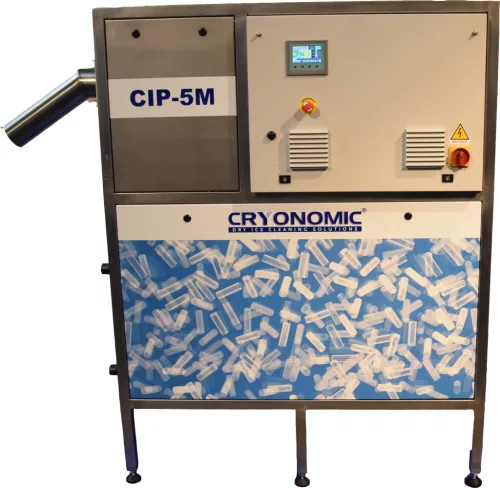
Recommended equipment: CRYONOMIC CIP-5M
CRYONOMIC CIP-5M
An industrial pelletizer that produces up to 180 kg/h of dry ice pellets (3, 10 or 16 mm), with production autonomy — produce exactly what you need, when you need it, with lower transport losses.
ROI and risk
Cost per kg under control, lower transport losses
- At your monthly consumption and purchase price, in-house production eliminates the buying cost and reduces the sublimation loss — we calculate the payback on your own figures
- Less dependence on the pellet supplier, no minimum orders or delivery windows — produce on demand
- Pellets sized to the application (3–16 mm), without depending on what the supplier has in stock
- Rated electrical power 7.5 kW — the basis for a cost per kg you compare directly with the purchase price
- Financing: purchase, GRENKE leasing or AUTONOM long-term equipment rental
Frequently asked questions
What we get asked most
How much does dry ice cost, and why does the bill keep growing?+
Why produce dry ice instead of buying it?+
How much dry ice does it produce?+
What pellet sizes can I make and what are they used for?+
Does the investment pay off compared with buying?+
What is needed to operate it?+
Can I use the pellets for both blasting and cooling?+
Can the equipment be financed?+
Show us what needs cleaning.
We'll help you decide what to test first.
Send us a few details, photos or a short video of the application. Within one working day, a technical sales consultant will review it and come back with the next best step — additional questions, a first recommendation or a proposed test.