Clean difficult industrial contamination without adding water or abrasive blasting media.
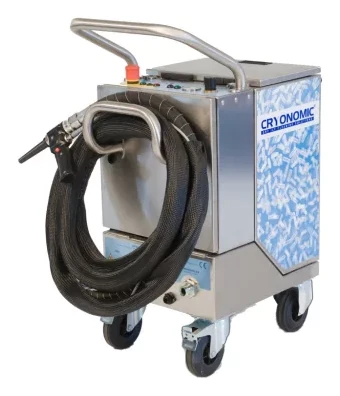
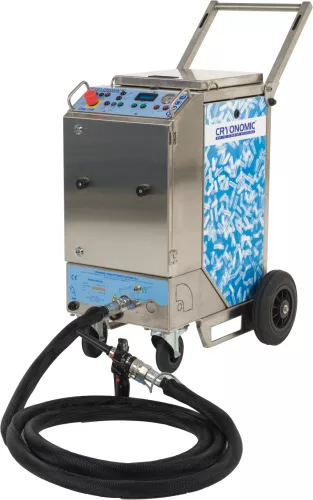
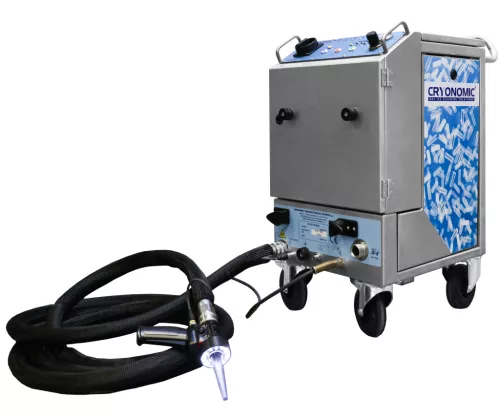
Dry-ice pellets are accelerated by compressed air and sublimate after impact. In suitable applications, this can reduce secondary cleanup, disassembly and production downtime.
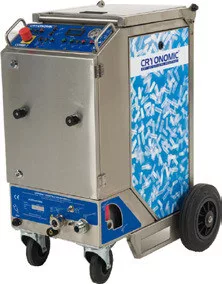
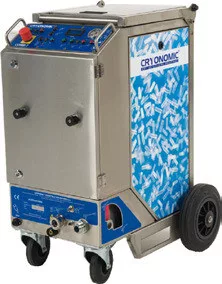
Browse Dry-Ice Blasting Machines →When would we test dry ice first?
- Tool and mould cleaning, especially when parts must be cleaned in place, still hot
- Equipment with costly or slow disassembly
- Grease, process oils or release agents to remove
- Applications where water is not permitted (electrical cabinets, motors, automation)
- Applications where a secondary abrasive medium cannot be collected
How it works
CO₂ pellets at -78.5 °C detach deposits by thermal shock, then sublimate — straight to gas, no water as the cleaning medium and no secondary abrasive medium; the effect on the surface depends on material, contamination and working parameters.
| Parameter | Value |
|---|---|
| Pellet temperature | -78.5 °C (solid CO₂) |
| Blasting pressure | 1–16 bar, depending on model |
| Pellet consumption | 20–80 kg/h, adjustable |
| Compressed air | 0.5–6.5 m³/min with one hose, depending on model and pressure (up to 13 m³/min with two hoses) |
Choose when
- Electrical cabinets, motors, automation — a dry process without water; on energised equipment only after a site-specific electrical safety review, under the equipment manufacturer's procedures and with qualified personnel
- Cleaning in place, often without full disassembly of the line
- Bottling lines and food zones where water or abrasive media are unwanted
- Surfaces that tolerate no abrasion — the pellet is soft, with low risk to the substrate; test on a sample
Avoid when
- Routine daily sanitation — if steam handles the soil, there is no reason to use up pellets
- Adherent rust or paint — thermal shock will not lift them; choose laser or blasting
- Night shifts with strict noise limits — the jet and compressor are audible
What changes in the operation
DOCUMENTED APPLICATIONS OF THIS TECHNOLOGY
A production line cleaned without disassembly
At the General Mills plant in Hannibal, Missouri, cleaning the production-line equipment dropped from eight hours to two, without disassembly (case study published by Cryoblast, the equipment supplier). Previously the line was shut down for one or more shifts while operators cleaned by hand.
General Mills, Hannibal, Missouri (USA) · Cryoblast, Milwaukee
Less wastewater, one operator instead of two
Chemiepack packs liquids and powders and used to clean its lines with pressurised water. After switching to dry ice, annual wastewater fell from about 300,000 to 130,000 litres, and cleaning that took two people is now done by one. The machines can keep running while being cleaned.
Chemiepack (Netherlands) · Cryonomic
Moulds cleaned in place, still at 300 °C
Varec makes rubber-to-metal parts and used to clean its compression moulds by sand blasting, five days a week — the abrasive eroded the moulds and left secondary waste to collect. With dry ice the moulds are cleaned in place while still at 300 °C: from eight hours to roughly 30 minutes.
Varec N.V., Mechelen (Belgium) · Cryonomic
DIRECT CUSTOMER PROOF FROM ROMANIA
Automotive · 24/7 operation
A customer relationship spanning more than 15 years
Continental Automotive Timișoara bought Cryonomic CAB 52 and COB 62 equipment from Meridian Invest in 2008. In 2009 the relationship expanded with a dedicated service agreement, and the business relationship continues today.
Automotive · three shifts
One year and eight months on three shifts, no failures
Dräxlmaier Hunedoara ran a Cryonomic COB 62 bought from Meridian Invest for one year and eight months of intensive three-shift use without a single failure. The supplier also trained the personnel operating the equipment.
What it requires on site
- Compressed air, depending on model
- Dry-ice pellet supply
- Ventilation and CO₂ management in the work area
- Personal protective equipment, per CE regulations
- Operating space for the gun, hose and collecting the detached contamination
Dry ice is powerful. It is not the answer to every cleaning problem.
It does not remove adherent rust, and it is not the cheapest method — the pellets are a real consumable. For rust or paint, laser or abrasive blasting is the right choice; for routine daily sanitation, if steam handles the soil, there is no reason to use up pellets.
Not sure if dry ice is the right method?
Send us 2–3 photos or a short video of the part, surface or contamination. We'll tell you whether dry ice is worth testing first — and what alternative we would compare it with.
Show us what needs cleaning.
We'll help you decide what to test first.
Send us a few details, photos or a short video of the application. Within one working day, a technical sales consultant will review it and come back with the next best step — additional questions, a first recommendation or a proposed test.